
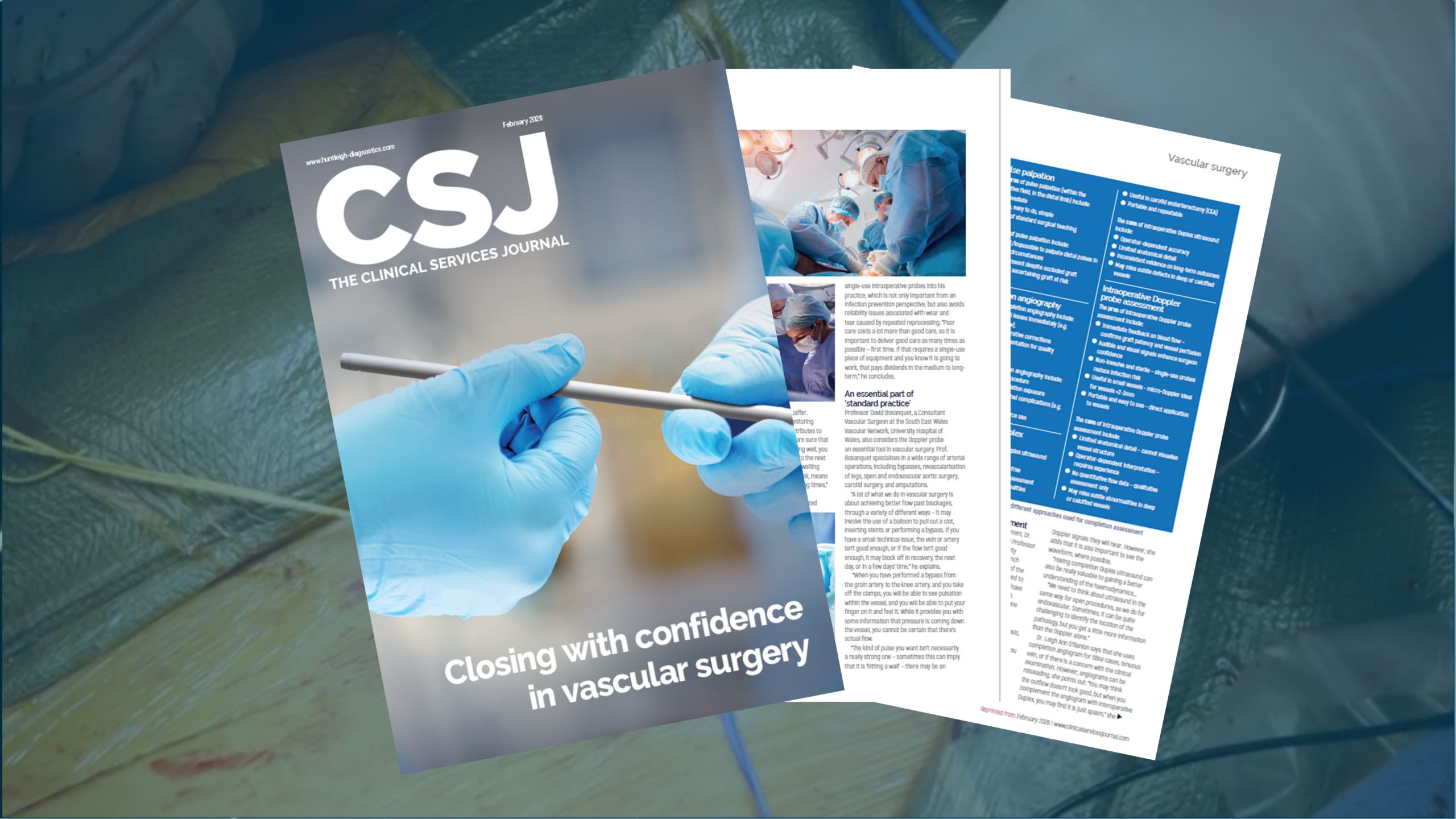
Ensuring successful blood flow at the end of a vascular procedure is one of the most critical moments in surgery. Across operating theatres worldwide, clinicians are increasingly turning to intraoperative Doppler ultrasound as a reliable, fast and cost‑effective way to confirm graft patency before closing, a shift that experts say can dramatically improve patient outcomes. 1
For decades, surgical teams have relied on a blend of pulse palpation, completion angiography and intraoperative Duplex ultrasound to verify flow. While all provide valuable insights, each carries limitations. Pulse palpation is subjective; angiography introduces radiation and contrast risks; Duplex can be operator‑dependent. In contrast, Doppler ultrasound offers an immediate, non‑invasive method of confirming blood flow with precision. 1
A Growing Consensus Among Leading Vascular Surgeons
The article highlights the perspectives of several respected vascular surgeons, all of whom emphasise the transformative role Doppler technology is playing in modern vascular practice.
“A must‑have tool, not a nice‑to‑have”
Professor Usman Jaffer describes Doppler as essential rather than optional particularly in patients with peripheral arterial disease and diabetes. He frequently employs Dopplex technology to verify triphasic waveforms during procedures such as femoral endarterectomy, noting that the combination of audible and visual feedback provides powerful diagnostic reassurance. 1
Reducing complications and boosting efficiency
Professor David Bosanquet considers Doppler probes “standard practice,” using them in every major case to avoid the risk of sending a patient to recovery with an undetected graft issue. He shares examples where Doppler assessment caught inadequate flow despite reassuring pulse palpation—cases where immediate correction prevented potential graft failure and emergency reoperation. 1
Critical support for less experienced surgeons
Dr. Leigh Ann O’Banion emphasises the value of Doppler for early‑career clinicians, helping them become familiar with the nuances of multiphasic signals. She urges that physiological assessment should come before imaging, reinforcing the reliability of Doppler as a first‑line completion check. 1
The Gap Between Guidelines and Real‑World Practice
Despite widespread support from leading surgeons, international vascular guidelines have not always reflected the routine use of intraoperative Doppler. Consultant surgeon Mr Lukla Biasi notes that guidelines often lag behind real-world practice due to slow evidence‑building processes. He advocates for Doppler’s inclusion in future recommendations to reflect its value in quality control, especially considering the risks associated with completion angiography, including a reported 1% stroke risk. 1
Survey data featured in the article highlights this inconsistency:
- 67% of surgeons still rely primarily on pulse palpation
- Only 13% “always” use intraoperative Doppler
- 23% routinely perform completion angiography
- 10% consistently use intraoperative Duplex ultrasound 1
These results reveal substantial variability in practice, evidence that clearer, updated guidance is needed.
Why Intraoperative Doppler Is Becoming the Standard
The article outlines several compelling advantages of Doppler technology:
- Immediate confirmation of graft patency
- Non‑invasive and radiation‑free approach
- Audible and visual feedback for confident decision‑making
- Single‑use sterile probes that reduce infection risk
- Applicability across a wide range of surgeries, including bypass grafts, carotid endarterectomy, kidney and liver transplantation, and even cosmetic flap surgery 1
As Professor Saratzis notes, while more large‑scale trials may be needed, the available observational data consistently shows that intraoperative Doppler is reliable, efficient and effective supporting the philosophy of “physiological assessment first, imaging second.” 1
Towards a Future of More Confident Closures
The overarching message is clear: intraoperative Doppler should be considered the minimum standard for completion assessment in revascularisation surgery, ensuring surgeons can “close with confidence” and patients receive the best possible outcomes. 1
As surgical teams strive for higher levels of safety, efficiency and consistency, Doppler technology is emerging as a cornerstone of modern vascular practice. Continued education, collaboration and evidence‑building will be essential to standardising its use globally and shaping the next generation of vascular guidelines.
Full Article
Read the complete Clinical Services Journal feature here:1 “Closing with Confidence in Vascular Surgery”